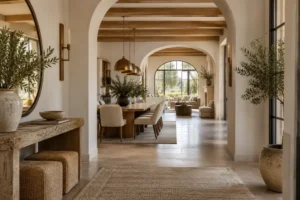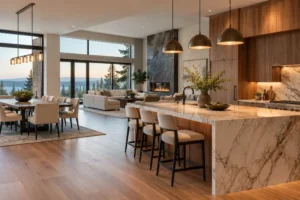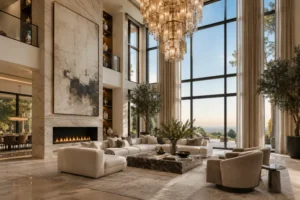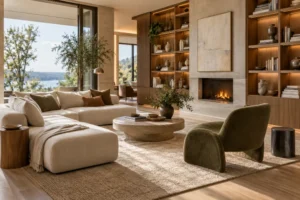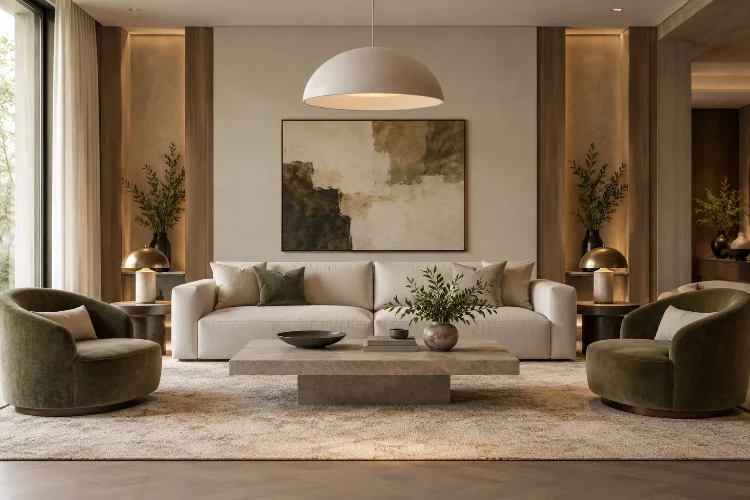
A sophisticated interior rarely looks impressive because of one expensive sofa, dramatic pendant light, or perfectly styled coffee table. What makes the space memorable is usually something less obvious: everything seems to sit exactly where it belongs.
That feeling comes largely from visual balance in contemporary interiors.
Visual balance is the way furniture, color, architecture, texture, lighting, and empty space distribute visual weight across a room.
It does not necessarily mean placing identical objects on opposite sides. In fact, many contemporary spaces feel more interesting when the arrangement is slightly uneven.
The goal is to create stability without making the room predictable.
This idea matters especially in contemporary interior design, where clean lines and relatively restrained decoration make proportion mistakes easier to notice. An oversized sofa, tiny artwork, heavy cabinet, or awkward lighting fixture can disrupt an otherwise beautiful room.
Understanding balance therefore helps transform a collection of attractive objects into a space that feels intentional, comfortable, and quietly sophisticated.
Why Visual Balance Matters More Than Perfect Symmetry
Balance and symmetry are closely related, but they are not the same thing.
Symmetrical interiors usually arrange similar elements around a central point. Imagine a bed with identical nightstands and lamps, or a fireplace surrounded by matching chairs. This approach naturally creates order and can make a room feel calm and grounded.
Contemporary interiors, however, often benefit from asymmetrical balance.
A large sofa on one side of a living room might be balanced by two lighter chairs, a tall floor lamp, and substantial artwork on the other. The objects are different, yet their combined visual presence prevents either side from feeling empty or overloaded.
Designers increasingly combine a symmetrical architectural framework with more relaxed asymmetrical furniture and accessories. The result feels structured without becoming overly formal.
That slightly imperfect composition often gives modern rooms their personality.
Scale and Proportion Create the Foundation
Before choosing decorative accessories, look at scale.
Scale describes how large an object feels relative to the room, while proportion describes how different elements relate to each other. Both strongly influence whether an interior feels natural or uncomfortable.
Consider a spacious living room with a high ceiling. A small two-seat sofa, tiny rug, and delicate pendant may technically fit, but visually they can appear lost.
The opposite problem happens in compact apartments. Bulky armchairs, oversized cabinets, and deep sofas can consume the available space and make circulation uncomfortable.
Good contemporary interiors usually mix sizes toughtfully rather than making everything equally large or equally small.
A substantial sofa might sit beside a slender side table. A large artwork can be paired with simple furniture. A dramatic pendant may provide enough visual mass to anchor an open dining area.
The relationship between objects matters more than their individual dimensions.
Visual Weight Goes Beyond Physical Size
A common decorating mistake is assuming visual weight depends only on size.
It does not.
Color, texture, shape, pattern, material, and contrast can make relatively small objects appear surprisingly dominant.
A compact black cabinet against a white wall may attract more attention than a much larger pale sofa. Similarly, a heavily patterned rug can visually occupy more space than a plain rug of exactly the same dimensions.
Material matters too. Thick dark timber usually feels heavier than clear glass. Solid stone appears more substantial than thin metal. A dense velvet chair carries a different visual presence from an open-frame chair.
This is why designers often contrast heavy furniture with visually lighter pieces. A bulky upholstered sofa, for example, can work beautifully beside a glass or slim-framed coffee table rather than another solid block of furniture.
These subtile contrasts stop contemporary rooms from feeling monotonous.
Furniture Placement Should Support the Architecture
Sophisticated rooms rarely look as though furniture has simply been pushed against available walls.
Instead, furniture usually responds to the architecture.
Windows, fireplaces, doorways, ceiling heights, structural columns, and sightlines all create natural visual anchors. Identifying these features first makes furniture placement much easier.
A fireplace may become the center of a conversational seating arrangement. Large windows might determine the direction of a sofa. In an open-plan home, a rug can establish the visual boundary of a living zone without building a physical wall.
Clear circulation also matters.
People should be able to walk through the room without weaving around tables or squeezing between chairs. When furniture blocks movement, the space often feels visually uncomfortable even before someone consciously understands why.
Try viewing the layout from the entrance of the room. If one area immediately feels crowded while another seems strangely empty, redistribution is probably neccessary.
Negative Space Gives Important Objects Room to Breathe
Contemporary design is not simply about owning fewer objects. It is about giving important objects enough space to matter.
Negative space – the deliberately unoccupied areas surrounding furniture, art, and architectural features – provides visual relief.
Imagine a sculptural lounge chair positioned against a relatively empty wall. Because the chair is not surrounded by several tables, plants, baskets, and decorative objects, its form becomes easier to appreciate.
The same principle applies to artwork.
One large piece displayed on a clean wall can sometimes create greater impact than several unrelated pieces competing for attention. Designers often treat negative space as an active part of the composition rather than leftover space that still needs decorating.
This restraint is especially important in contemporary interiors, where simplicity can communicate confidence.
The challenge is avoiding emptiness. A room still needs texture, warmth, and personality. Objects simply need to be edited rather than endlessly added.
Color and Texture Can Counterbalance Each Other
A balanced room does not require every material or color to appear in equal quantities.
Instead, designers often repeat selected tones or textures in smaller doses throughout the space.
Imagine a living room dominated by warm white walls and a beige sofa. A dark walnut cabinet may initially feel heavy. Repeating similar dark tones through a lamp base, picture frame, or coffee table creates a visual connection that makes the cabinet feel less isolated.
Texture works in a similar way.
Smooth plaster, polished stone, brushed metal, wool, linen, timber, and glass reflect light differently. Combining them gives depth to a neutral contemporary palette without relying on excessive color.
Contrast is particularly useful. Architectural Digest notes that designers often think about balance through opposites such as sheer versus heavy or glossy versus matte finishes.
The aim is not mathematical equality. It is a sense that different materials are intentionally connected rather than completely seperated from one another.
Lighting Changes How Balance Is Perceived
Furniture may create the daytime composition, but lighting can completely reshape it after sunset.
A large pendant becomes a visual anchor above a dining table. A floor lamp adds height to an otherwise low arrangement. Wall sconces can strengthen symmetry, while an off-center sculptural lamp can intentionally introduce asymmetry.
Lighting also influences perceived scale.
In large spaces, appropriately oversized fixtures can help make expansive rooms feel more intimate and visually grounded. Multiple smaller fixtures arranged as a group can create similar impact.
A sophisticated lighting scheme therefore considers more than brightness.
Ambient lighting establishes the general atmosphere, task lighting supports specific activities, and accent lighting draws attention toward art, furniture, or architectural details.
When those layers work together, the eye naturally moves through the room instead of becoming stuck on one excessively bright area.
Sophistication Often Comes From Controlled Imperfection
Perfect matching can create order, but too much repetition may make a contemporary interior feel staged.
One useful approach is establishing a balanced foundation and then introducing carefully controlled differences.
You might use two similar chairs rather than identical ones. Matching bedside tables can hold different lamps or accessories. A symmetrical sofa arrangement might be softened with an irregular coffee table and casually positioned artwork.
Designer advice increasingly supports this combination of structure and imperfection: begin with symmetry where stability is useful, then introduce variation through textures, furniture, art, or accessories.
This approach creates rooms that feel composed but still human.
And that distinction is important. Sophisticated contemporary interiors should not look like untouched showrooms. They should appear carefully considered while remaining comfortable enough for everyday life.
Visual balance is one of the quiet forces behind successful contemporary interior design. It connects furniture scale, proportion, visual weight, architecture, color, texture, lighting, and negative space into one coherent composition.
The goal is not perfect symmetry or rigid decorating rules. Instead, it is about understanding how each element affects everything around it.
Start by looking at your room as a whole rather than focusing on individual objects. Identify where visual weight feels concentrated, where the eye needs somewhere to rest, and whether furniture respects the architecture and circulation.
Then edit before adding more.
A sophisticated interior usually emerges when every element has enough presence to contribute – but enough restraint to let the rest of the room breathe.