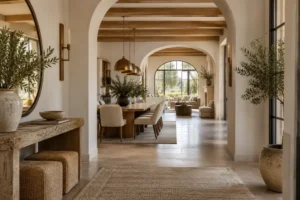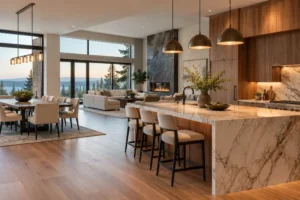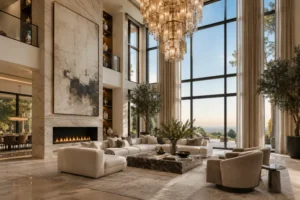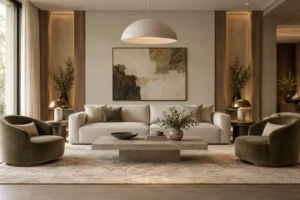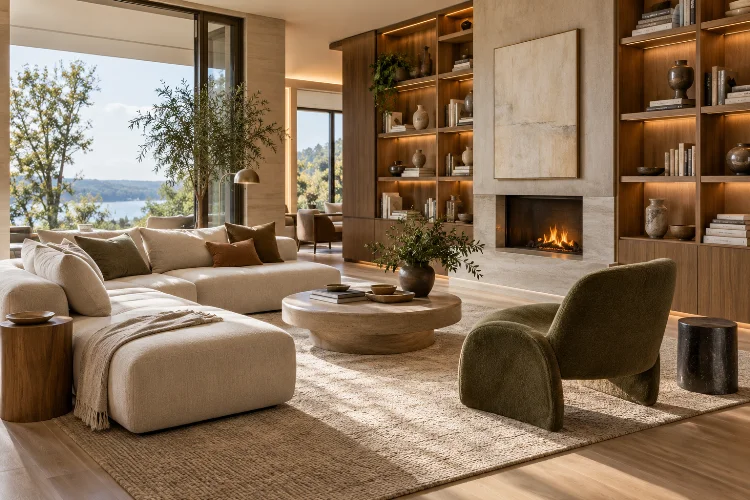
A beautiful room can still feel strangely uncomfortable. The furniture may be expensive, the colors may coordinate, and every decorative object might look great on its own, yet something about the overall space simply feels disconnected.
That is where advanced interior design principles become important.
Good interiors are not created by filling rooms with fashionable pieces. They are shaped by relationships: how furniture relates to architecture, how light changes materials, how the eye moves through a room, and how people naturally circulate from one area to another.
Professional designers often work with concepts such as balance, rhythm, emphasis, proportion, scale, and harmony as the foundation of a successful scheme.
The interesting part is that these principles do not require a huge renovation budget. Even relatively simple decisions – moving a sofa, changing the scale of a rug, adjusting lighting, or reducing visual clutter – can completely transform how a home feels.
Understanding these deeper ideas makes it easier to create living spaces that are stylish, functional, comfortable, and genuinely personal.
Start With Harmony, Not Individual Objects
One of the biggest differences between casual decorating and advanced interior design is the way decisions are made.
Instead of asking, “Do I like this chair?” consider asking, “What role does this chair play in the entire room?”
Harmony appears when individual elements feel connected through color, form, scale, materials, or visual language. They do not need to match perfectly. In fact, rooms filled with identical furniture can easily feel more like a showroom than a home.
A curved armchair, rectangular sofa, sculptural lamp, and vintage timber table can all coexist if something visually connects them. That connection might come through repeated colors, similar proportions, complementary textures, or a consistent level of visual weight.
The objective is cohesion rather than uniformity.
A toughtful interior usually feels as though every item has been intentionally invited into the conversation.
Balance Visual Weight Across the Room
Balance is one of the most important foundations of interior composition. Designers consider not only physical size but also color, texture, contrast, shape, and negative space when evaluating how visually heavy an object feels.
For example, a large cream sofa may appear lighter than a much smaller black cabinet because darker colors often attract stronger visual attention.
This means balance does not always require symmetry.
You could place a substantial sectional sofa on one side of a living room and counter it with two lighter chairs, a floor lamp, and a piece of artwork on the opposite side. Although the objects are different, the composition can still feel stable.
Negative space also contributes to balance.
If every wall, corner, shelf, and surface is occupied, the room loses opportunities for visual rest. Leaving selected areas intentionally empty allows important furniture and architectural details to stand out.
Use Scale and Proportion to Make Spaces Feel Natural
A room can contain beautiful furniture and still feel awkward when its proportions are wrong.
Scale concerns the relationship between an object and the surrounding space, while proportion describes the relationship between different objects.
Imagine placing a tiny rug beneath a large sectional sofa. The rug might be attractive, but it visually disconnects the seating arrangement. A generously sized rug, by contrast, can anchor multiple pieces and make them feel like one composition.
Ceiling height matters too.
Rooms with tall ceilings can usually support larger pendant lights, taller shelving, oversized artwork, or stronger architectural features. In a compact apartment, furniture with thinner legs and more open forms may preserve a greater sense of visual space.
The goal is not to follow a mathematical formula for every object. Instead, pay attention to whether one element appears unusually dominant or insignificant compared with everything around it.
When proporton feels right, people often experience a room as comfortable without immediately knowing why.
Create Rhythm and Visual Hierarchy
A sophisticated interior guides the eye instead of demanding attention everywhere at once.
This is where rhythm and visual hierarchy become useful.
Rhythm can be created by repeating colors, materials, forms, patterns, or heights throughout a room. Interior designers use repetition, contrast, emphasis, and proportion to create visual movement and prevent spaces from appearing flat.
For example, the warm tone of a walnut dining table could reappear in shelving, picture frames, and smaller decorative details. Those repeated notes subtly connect different areas.
Hierarchy determines what viewers notice first, second, and third.
Every major room benefits from a focal point. It might be a fireplace, artwork, dramatic window, sculptural light fixture, or distinctive piece of furniture.
Once that focal point is established, surrounding elements should support it rather than compete with it. When everything is bold, oversized, colorful, or patterned, nothing actually feels special.
Design Circulation Before Decorating
One of the most overlooked principles of residential interior design is circulation.
A room is not just something people look at. It is something they continually move through.
Before finalizing furniture placement, imagine the paths people naturally take between entrances, seating areas, kitchens, windows, outdoor spaces, and adjacent rooms.
Frequently used pathways generally benefit from generous clearance. ArchDaily notes that around 90 centimeters is commonly recommended for major circulation routes, although the appropriate distance ultimately depends on the specific space and its use.
Furniture can also define zones without requiring physical partitions.
An open-plan living area might use a sofa to establish the edge of the lounge, a pendant to visually anchor the dining table, and a rug to define the seating zone.
Contemporary residential projects increasingly demonstrate how circulation, light, and visual connections can create fluid spaces without turning everything into one undefined open room.
Good spatial flow should feel effortless rather than neccessary to consciously navigate.
Layer Materials, Colors, and Textures
Harmony does not mean using one material everywhere.
Some of the richest interiors rely on contrast.
Smooth stone can sit beside textured timber. Matte plaster can balance polished metal. Linen upholstery can soften the harder appearance of glass or concrete.
The key is controlled variety.
If every surface introduces a completely different material, color, and pattern, the space can become visually exhausting. Instead, establish a limited material vocabulary and repeat it in slightly different ways.
Color should work similarly.
A dominant neutral palette can be layered with several related shades rather than one identical beige repeated throughout the entire house. Adding darker accents gives depth, while muted complementary colors can introduce personality.
Texture becomes especially useful in restrained contemporary interiors because it provides richness without requiring excessive ornament.
Even subtile differences between wool, linen, timber, plaster, leather, and stone can make a neutral space feel considerably more dimensional.
Treat Lighting as Part of the Architecture
Lighting should never be an afterthought.
A single bright ceiling fixture can technically illuminate a room, but it rarely creates much atmosphere.
A stronger approach combines ambient, task, and accent lighting. Ambient light establishes general illumination, task lighting supports specific activities, and accent lighting emphasizes artwork, architectural details, or decorative features.
Consider a living room.
Recessed or ceiling lighting might provide the practical foundation. A floor lamp beside an armchair supports reading, while wall lights or picture lights create softer evening illumination.
Different fixtures also add visual height and rhythm.
Lighting can even change how materials are perceived. Timber looks warmer under softer illumination, textured walls become more dramatic when light moves across their surface, and metallic finishes respond differently depending on the direction of the light.
For harmonious interiors, plan lighting alongside furniture and finishes rather than adding fixtures only after everything else is complete.
Design for Human Experience, Not Just Appearance
Perhaps the most advanced principle is also the simplest: a home needs to work for the people living in it.
A beautifully photographed interior is not automatically a comfortable one.
Think about daily routines. Where do people place their keys? Where do guests naturally sit? Does someone read near a window? Does the family gather around a kitchen island? Is there enough storage where it is actually needed?
Successful design connects aesthetics with behavior.
That could mean choosing an attractive sideboard that also hides everyday clutter, positioning chairs to encourage conversation, creating softer lighting for evenings, or using durable materials in heavily used areas.
The result may be less visually perfect than a staged showroom, but it will usually feel far more authentic.
A harmonious home supports daily life instead of constantly asking its occupants to adapt to the design.
Advanced interior design principles are ultimately about relationships rather than decoration.
Balance controls visual weight, proportion helps furniture fit naturally into its environment, rhythm guides the eye, circulation improves movement, and layered lighting changes both function and atmosphere.
The best interiors also leave room for personality. Design rules should provide structure rather than eliminate individuality.
Instead of trying to transform your entire home at once, choose one room and study how it currently works. Look at its focal point, furniture scale, circulation, empty space, textures, and lighting throughout the day.
Then make deliberate changes one layer at a time. When every design choice supports both the architecture and the people using it, harmony becomes much easier to achieve.