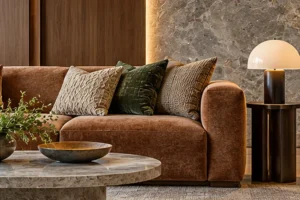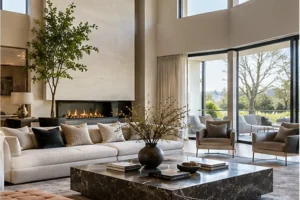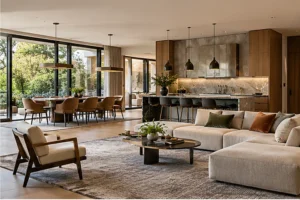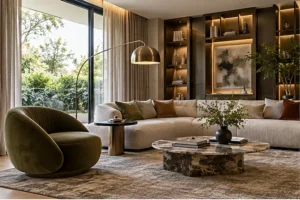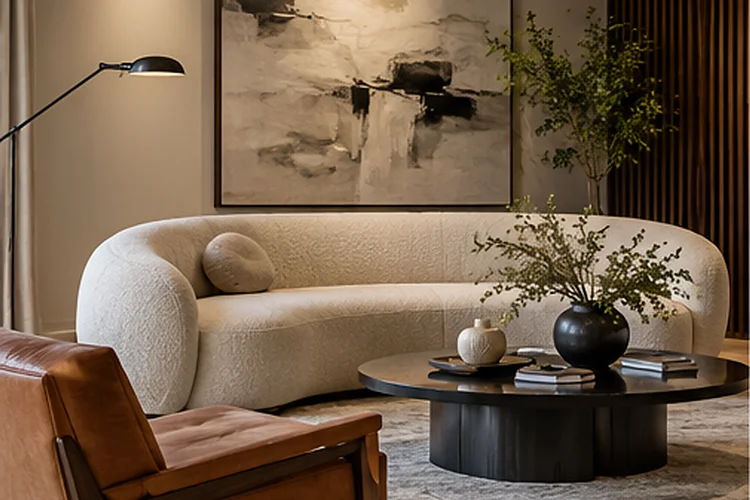
Contemporary rooms often look their best when they avoid choosing between two extremes. Too many straight lines can make a space feel rigid and overly architectural, while an interior filled entirely with rounded furniture can start to look overly soft or themed.
The solution is contrast.
Learning how to balance curved and angular furniture in contemporary rooms allows you to combine structure with softness.
Angular sofas, cabinets, tables, and architectural details provide visual order, while rounded chairs, curved sofas, circular tables, and sculptural accessories introduce movement.
This contrast is especially relevant in current interiors. Recent design coverage continues to highlight curved and organic furniture, but designers are frequently pairing those softer silhouettes with cleaner architectural lines instead of creating rooms made entirely from curves.
The trick is not achieving a perfect 50/50 split. A successful room usually establishes one dominant visual language and then introduces the opposite form strategically.
When done well, the result feels relaxed, sophisticated, and far more interesting than a room where every object follows the same geometry.
Start With the Architecture of the Room
Before choosing furniture shapes, study the lines already built into the space.
Most contemporary homes contain plenty of angular geometry. Walls meet at right angles, windows are usually rectangular, cabinetry follows straight lines, and flooring often creates a visible grid.
That means the architecture may already provide more than enough structure.
In this situation, introducing a curved sofa, rounded armchairs, or an oval coffee table can soften the room without making it lose its contemporary character. Designers frequently use curves specifically to counterbalance formal architectural lines and create greater visual flow.
The opposite can also happen.
If your home features arched openings, curved walls, rounded kitchen islands, or organic architecture, highly sculptural furniture everywhere may become excessive. Straight-lined consoles, rectangular rugs, or angular side tables can provide the visual discipline the room needs.
Think of architecture as the first layer. Furniture should respond to it rather than ignore it.
Choose One Shape Language to Dominate
Balanced design does not require an equal number of curved and angular pieces.
In fact, trying to achieve exact equality can make the room feel overly calculated.
Instead, choose a dominant shape language.
For example, your living room might contain a rectangular sofa, linear media unit, square rug, and architectural shelving. A rounded coffee table and two curved lounge chairs could then provide the softer counterpoint.
Alternatively, a room built around a curved sectional might use a rectangular stone coffee table, angular floor lamp, and structured shelving to keep the composition grounded.
Homes & Gardens designers have suggested that curves work particularly well when they are layered rather than repeated everywhere. One designer even recommends letting straight lines remain dominant while using curved silhouettes more selectively to create visual rhythm.
The exact percentage is less important than the idea.
One language creates order. The other creates contrast.
Use Scale to Make Opposing Shapes Feel Related
Shape is only one part of furniture balance.
Scale matters just as much.
A huge curved sofa paired with a tiny rectangular coffee table may feel awkward even though the shapes technically contrast. Their visual weights are too different.
Instead, choose angular and curved pieces with comparable presence.
A large serpentine sectional might need a substantial rectangular or irregular stone table. A compact curved chair could be paired with a smaller square side table rather than an oversized cabinet.
Contemporary living rooms featured by Architectural Digest frequently demonstrate this principle, combining angular architectural details with curved sofas and tables while maintaining similar visual weight across the composition.
Height matters too.
If most of your furniture is low and curved, introduce a taller linear lamp, shelving system, or vertical artwork. This prevents the entire room from visually sinking toward the floor.
Balanced scale makes different shapes feel related rather than randomly collected.
Let Curves Soften Hard Architectural Lines
Curves are especially useful in rooms dominated by rectangles.
A boxy sectional, rectangular windows, straight cabinetry, and square rug can create plenty of structure, but the repetition may eventually feel stiff.
One curved element can interrupt that geometry.
A circular coffee table is one of the easiest options. Designer Shea McGee has specifically used organic coffee tables to break up straight furniture arrangements and make living rooms feel fresher and less rigid.
Curved chairs can achieve the same effect.
Their rounded backs interrupt horizontal and vertical lines while naturally turning seating toward the center of the conversation.
Even smaller objects can help. A globe lamp, rounded ceramic vase, circular mirror, or organically shaped side table can introduce softness without replacing major furniture.
The goal is not to make every corner rounded.
Curves are most noticeable when there are enough straight lines around them to create contrast.
Use Angular Furniture to Ground Organic Forms
Curved rooms can have the opposite problem.
When a sofa, chairs, ottoman, coffee table, rug, lighting, and accessories are all rounded, the design may start to lose definition.
Angular furniture introduces visual stability.
Imagine a cream curved sofa paired with a sharp-edged walnut console. The sofa feels soft and inviting, while the console adds structure behind it.
A rectangular rug can also frame a rounded seating arrangement.
Likewise, straight shelving creates a useful architectural backdrop for sculptural furniture.
Architectural Digest has documented contemporary interiors where curved chairs are deliberately positioned against angular cabinetry, doorways, or other straight-lined pieces, allowing each geometry to make the other more noticeable.
This is why contrast works so well.
Angular pieces make curves look more fluid, while curves prevent straight pieces from becoming too severe.
Neither form needs to win.
Connect Different Shapes Through Color and Materials
When furniture shapes are very different, another element needs to create cohesion.
Color is often the easiest solution.
A boxy sofa and curved chair can feel naturally connected when both use related neutral tones. They do not need identical upholstery; even variations of beige, taupe, olive, charcoal, or cream can establish a visual relationship.
Materials work similarly.
A rectangular walnut coffee table might connect with the timber frame of a curved chair. A rounded marble side table can reference the stone surface of an angular fireplace.
Designers also use consistent textures to keep mixed silhouettes cohesive. One recent living-room example combined boxier and curved sofas through similar color and luxurious materials, allowing their different shapes to feel intentional rather than mismatched.
This strategy is particularly useful when mixing furniture from different periods.
Shape can vary dramatically when color, material, or finish provides a common thread.
A subtile connection is usually enough.
Repeat Curves and Angles at Different Scales
One isolated curved chair in a room full of rectangles can sometimes look accidental.
Repeating the curve once or twice makes the decision feel intentional.
If you introduce a curved sofa, you might echo its shape through a round side table or spherical lamp. The pieces do not need identical curves; the repetition simply gives the eye another reference.
Do the same with angular forms.
A rectangular coffee table might relate to picture frames, shelving divisions, or the geometry of a rug.
This creates rhythm.
Repetition should happen at different scales rather than through matching furniture sets.
For example, the largest curve might be the sofa, the medium curve a side table, and the smallest a ceramic object. Straight geometry could appear in the rug, console, and artwork.
That variation prevents the room from feeling formulaic.
The result appears intensionally layered rather than designed around a strict shape theme.
Think About Circulation Around Curved Furniture
Curved furniture affects movement differently from rectangular furniture.
A curved sofa often projects into a room in unexpected places. A circular coffee table occupies its footprint differently from a rectangular one, while rounded chairs may require more clearance around their backs.
Measure before buying.
Marking furniture dimensions on the floor is particularly useful with unusual silhouettes because standard width and depth measurements do not always explain how the piece occupies space.
Curves can actually improve circulation when used correctly.
Rounded coffee tables eliminate sharp corners around busy seating areas, while curved sofas can help direct people naturally around rather than through a conversation zone.
They can also encourage more social layouts. Vladimir Kagan’s famous curved sofa designs, for example, were conceived partly around creating sculptural furniture that moved away from walls and encouraged conversation.
But enough negative space remains essential.
Beautiful curves need room to be seen.
Use Texture to Strengthen Shape Contrast
Different textures can make geometric differences even clearer.
Imagine a curved bouclé chair beside a sharp-edged glass table. One feels tactile and soft, while the other feels precise and visually light.
That contrast adds another layer beyond shape.
Recent design coverage has continued to combine soft upholstery, organic timber, metal, glass, velvet, and other contrasting finishes to balance rigid and organic forms.
Try pairing:
A curved velvet sofa with a linear metal console.
A rectangular timber table with rounded upholstered chairs.
A structured leather sofa with a soft circular wool rug.
The point is not to maximize differences everywhere.
Choose one or two strong contrasts and allow quieter materials to connect them.
If every object has a completely different shape, texture, color, and finish, visual balance disappears.
Leave Negative Space Around Strong Silhouettes
Sculptural furniture needs breathing room.
Curves in particular are easiest to appreciate when their full outline remains visible.
Do not push a beautifully rounded lounge chair tightly against another piece just because floor space is available. A little empty area around it helps the eye understand its shape.
The same principle applies to angular statement furniture.
A sharp architectural console or geometric chair becomes more powerful when it is not surrounded by excessive accessories.
Negative space also stops a mixed-shape room from becoming visually exhausting.
Recent open-plan interiors continue to demonstrate how exposed floor area can separate furniture groupings and make individual materials or silhouettes easier to read.
A balenced room is therefore not created only by furniture.
The empty space between curved and angular objects plays an equally important role.
Balancing curved and angular furniture is one of the easiest ways to make a contemporary room feel more dynamic. Straight lines provide structure and clarity, while curves soften the composition and encourage visual movement.
Start with the architecture, decide which geometry should dominate, and introduce the opposite form selectively. Pay attention to scale, repeat shapes at different levels, and connect contrasting pieces through color, materials, or texture.
Most importantly, leave enough breathing room for strong silhouettes to remain visible.
Look around your room and identify which shape currently dominates. If everything feels rigid, introduce one meaningful curve. If the scheme feels overly rounded, add a structured linear piece. A few proportionaly considered contrasts can completely change the character of the space.