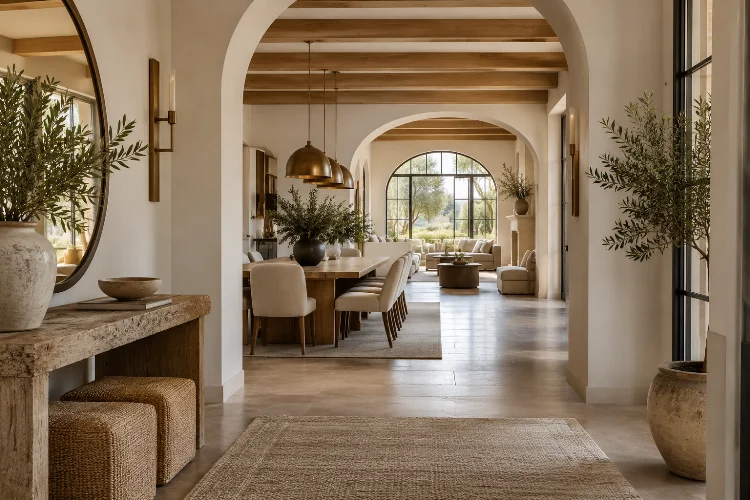
Some homes feel naturally connected from the moment you walk through the door. The living room may look completely different from the kitchen, and the bedroom might have its own personality, yet every space still seems to belong to the same story.
That sense of continuity rarely happens by accident.
One of the most effective ways designers create it is through rhythm and repetition in home design. Rhythm guides the eye through an interior, while repetition creates recognizable connections by reusing colors, materials, forms, patterns, or architectural details.
Designers often describe rhythm as a principle that creates movement and visual flow, helping the eye travel naturally around a space rather than becoming stuck on isolated elements.
The trick is not repeating everything exactly. Too much repetition becomes predictable, while too little can make rooms feel unrelated.
Successful interiors find the middle ground: enough familiarity to create harmony, combined with enough variation to keep the home interesting.
Understand Rhythm as Visual Movement
Rhythm in interior design works surprisingly like rhythm in music.
A song uses recurring beats, pauses, changes in intensity, and repeated melodies to create structure. Interiors can achieve something similar through recurring visual elements.
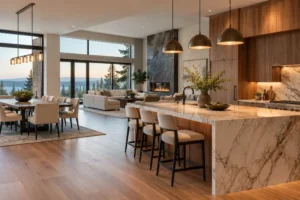
A row of pendant lights above a kitchen island creates rhythm through repeated shapes. Timber ceiling beams establish another pattern, while several pieces of artwork placed at similar intervals can lead the eye along a wall.
Rhythm can also come from progression rather than identical repetition. Objects might gradually increase in height, colors can move from pale to dark, or furniture forms may shift from low horizontal shapes toward taller vertical pieces.
Design guidance commonly connects rhythm with repetition, progression, contrast, and movement because these techniques prevent interiors from feeling static.
The goal is to make the eye want to continue exploring.
Repeat Colors Without Making Every Room Identical
Color is one of the easiest tools for creating continuity across a home.
That does not mean every room needs the same wall color.
Instead, choose several core tones that reappear in different proportions. A deep green used on kitchen cabinetry might return as a smaller accent in living room cushions, artwork, or an upholstered chair.
Architectural Digest notes that whole-home palettes often work best when rooms visually inform one another through repeating elements such as color, scale, and texture rather than following an identical formula everywhere.
You can also vary intensity.
Perhaps warm terracotta appears strongly in a dining room, then returns as a muted rust-colored textile in the bedroom. The connection remains recognizable, but the experience changes.
This approach is far more flexible than using exactly the same colors everywhere.
The objective is a consistant visual thread, not a house where every space looks copied and pasted.
Create Continuity Through Materials
Materials can establish rhythm just as effectively as color.
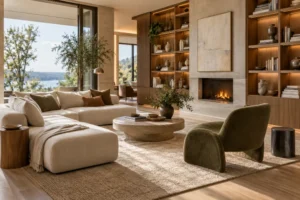
Imagine a home where oak appears on the kitchen cabinetry, returns on a living room shelving unit, and then appears again as a bedside table upstairs. Those repeated touches immediately create a relationship between separate rooms.
Stone, metal, plaster, glass, and textiles can work the same way.
A brushed brass kitchen tap might connect with lighting fixtures elsewhere. Travertine used heavily in a bathroom could return more subtly as a side table in the living space.
This technique becomes especially powerful in open-plan interiors where several functional areas are visible at once.
Repeated materials give the eye familiar reference points, making different zones feel related even when their furniture arrangements are unique.
The repetition does not need to be obvious. In many sophisticated interiors, these connections are deliberately subtile.
People may not consciously notice that the same timber finish appears five times throughout the house, but they still experience the result as coherent.
Use Shapes and Forms as Recurring Motifs
Repetition does not have to involve identical objects.
Sometimes repeating a shape is enough.
Imagine an interior containing an arched doorway. That curved form could reappear in a rounded mirror, curved sofa, circular side table, or sculptural light fixture.
Nothing actually matches, yet the repeated geometry creates a recognizable visual theme.
Houzz describes repetition of forms such as circles, squares, and rectangles as a useful way to establish rhythm and consistency within interiors.
Architectural repetition can work on a larger scale.
For example, repeated vertical timber battens can establish a strong rhythmic pattern across an architectural surface.
ArchDaily has documented residential projects where repeated battens and mullions create a distinct vertical rhythm while maintaining visual layers and connections through the building.
The principle is simple: identify one or two shapes already present in the architecture and allow them to reappear elsewhere.
Those echoes help the space feel intentionally composed.
Repeat Patterns With Controlled Variation
Pattern can create powerful rhythm, but it needs restraint.
Using the same strong pattern on curtains, rugs, cushions, wallpaper, and upholstery would probably overwhelm the room.
Instead, designers often repeat patterns selectively.
A fabric used for curtains might reappear on two cushions rather than covering the entire seating arrangement.
Architectural Digest has highlighted this approach, showing how repeated fabrics across nearby rooms can create connections while allowing individual spaces to maintain their own identity.
Pattern can also repeat conceptually rather than literally.
A striped rug might relate to vertical wall paneling. Geometric cushions could reference the rectangular divisions of nearby cabinetry.
These relationships create rhythm without becoming too obvious.
Another useful strategy is changing scale. A large botanical pattern could appear alongside a much smaller organic motif rather than being repeated at exactly the same size.
Variation keeps repetiton from turning into monotony.
Connect Rooms Through Architectural Details
Some of the strongest repetition happens before furniture and decoration are even considered.
Doors, trims, flooring, ceiling details, wall paneling, window frames, and built-in cabinetry can create architectural rhythm throughout a home.
Homes & Gardens notes that repeated decisions such as consistent trim profiles or recurring timber finishes can help separate rooms feel connected rather than unrelated.
This is particularly useful in houses containing many enclosed rooms.
If each room has a different color scheme, furniture style, and function, consistent architectural details can still create a stable background.
You might use the same door style throughout, maintain a common skirting profile, or carry one flooring material through major circulation areas.
Repetition in architecture can also create physical movement.
In the Tull Weekend Home in Japan, for example, repeated geometric volumes and timber portal structures create a circular rhythm across the residential composition.
The effect demonstrates how repetition can organize not only decoration but also spatial experience.
Let Lighting Establish a Repeating Beat
Lighting is another useful way to create rhythm.
A sequence of matching pendants above an island immediately establishes a beat because the eye recognizes their regular spacing.
Hallway lights, wall sconces, and recessed fixtures can create similar visual progression.
However, repetition does not always mean using the exact same light fixture throughout the entire house.
A stronger approach is often to repeat characteristics.
Different fixtures might share the same brass finish. Another group could repeat frosted glass, spherical shapes, or black metal detailing.
This creates continuity while still allowing each room to respond to its own scale and function.
Think of lighting as a family rather than a matching set.
The fixtures should feel related, but they do not need to look identical.
This is especially valuable when moving between public and private areas. A dramatic dining pendant and a quieter bedroom lamp can still feel connected if they share a material, form, or finish.
Break Repetition Before It Becomes Boring
Repetition creates cohesion, but contrast keeps the interior alive.
If every chair, light, fabric, timber finish, and decorative object follows the same visual rule, the design can become overly controlled.
Homes & Gardens warns that too much repetition can feel monotonous, just as excessive contrast can make a room feel disorganized. The strongest interiors balance recurring elements with intentional differences.
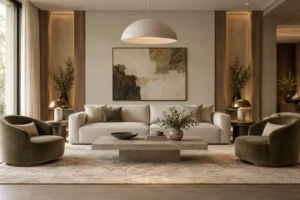
Imagine a living room built around warm timber, soft beige upholstery, rounded furniture, and neutral fabrics.
Introducing one angular black chair could provide exactly the contrast the room needs.
The chair works because everything around it establishes a clear rhythm first.
Try thinking in terms of patterns and interruptions. Repeat an element enough times for the eye to recognize it, then introduce something unexpected.
That break gives the composition personality.
A toughtful interior therefore does not ask, “How can I make everything match?”
A better question is, “Which elements should repeat, and where should I deliberately change the pattern?”
Use Repetition Across the Whole Home
Cohesion becomes particularly important when designing an entire house rather than one isolated room.
Start by identifying a limited set of recurring design elements.
You might choose warm oak, aged brass, soft plaster tones, rounded furniture, and muted green accents.
Each room can then interpret those ingredients differently.
The kitchen may feature oak cabinetry heavily, while the living room uses only an oak coffee table. Brass might dominate the bathroom fittings but appear only as small lamp details in the bedroom.
This creates what could be called visual memory.
When someone moves through the house, familiar elements repeatedly appear in slightly different forms.
The rooms remain individual, yet they never feel completely seperated from one another.
That is ultimately what a cohesive home design scheme should achieve: consistency without sacrificing personality.
Rhythm and repetition are powerful because they create order without requiring everything to match. Repeated colors, materials, shapes, patterns, architectural details, and lighting can quietly connect rooms and guide the eye through a home.
The most successful schemes also understand when repetition should stop.
Too much consistency becomes predictable, while strategic contrast keeps a space interesting and personal. Think of recurring design elements as a visual thread running through the house rather than a rigid decorating formula.
Take a walk through your own home and identify the colors, materials, or forms that already appear more than once.
Choose a few worth developing further, then repeat them intentionally across different spaces. Small visual echoes can create a surprisingly strong sense of flow and make an entire home feel far more considered.