Have you ever seen a beautiful sofa in a showroom, brought something similar home, and wondered why it suddenly looked enormous? Or perhaps you placed several elegant small pieces in a spacious living room only to find that everything seemed strangely lost.
The issue is usually scale.
Understanding the relationship between furniture scale and room size is one of the foundations of successful interior design.
Scale describes how large an object feels in relation to its surroundings, while proportion considers how individual pieces relate to one another. When both work together, a room feels balanced without looking overly calculated.
Designers often describe scale as something people notice emotionally before they understand technically. A coffee table may simply “feel too small,” or a sofa can seem overwhelming even when it physically fits.
The goal is not to follow a rigid formula. Instead, it is about understanding room volume, furniture dimensions, circulation, ceiling height, and visual weight so every object feels like it belongs.
Start With Room Volume, Not Just Floor Area
Room size is more than length multiplied by width.
Ceiling height dramatically changes how large a space feels. A 25-square-meter room with a low ceiling can feel completely different from one with a double-height volume.
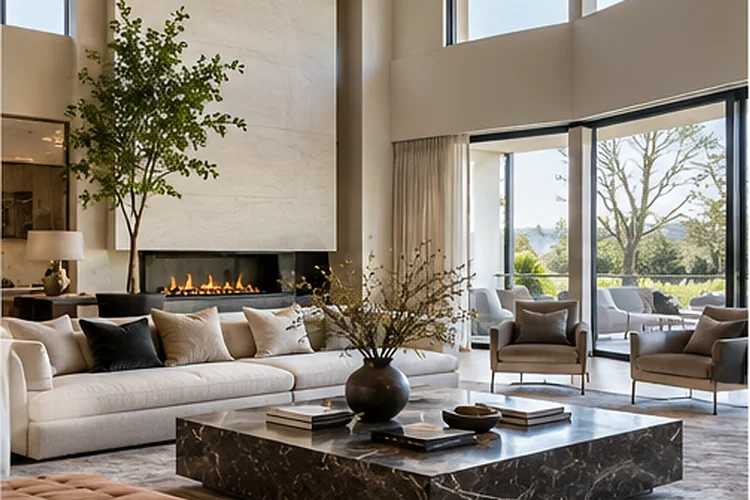
Higher ceilings generally support taller furniture, oversized lighting, large artwork, substantial plants, and stronger vertical elements.
Designers often recommend scaling furnishings upward in rooms with generous ceiling heights so the furniture does not appear lost beneath the architecture.
Rooms with lower ceilings usually respond better to lower furniture and simpler vertical arrangements.
Windows matter too. A room with expansive glazing can visually extend beyond its physical boundaries, while smaller windows and enclosed walls may make the same floor area feel more intimate.
Before shopping, therefore, study the whole architectural envelope.
You are furnishing volume, not simply filling available floor space.
Understand Scale Versus Proportion
Scale and proportion are often discussed together, but they solve different problems.
Scale asks whether the furniture feels appropriate for the room itself. Proportion asks whether one piece feels appropriate beside another.
Imagine a three-meter sectional in a large living room. Its scale might be perfect for the architecture. But if you pair it with a tiny coffee table and one narrow side chair, the furniture proportions will still feel wrong.
Homes & Gardens describes scale as the relationship between objects and the surrounding room, while proportion concerns how different sizes relate to one another. Both contribute to interiors that feel grounded and harmonious.
This is why buying every item individually can be risky.
Instead of asking whether you love a particular chair, consider how its height, depth, width, and visual weight relate to the sofa, table, rug, and room around it.
A successful scheme is a collection of relationships.
Do Not Automatically Use Tiny Furniture in Small Rooms
One of the oldest decorating assumptions is that small rooms require small furniture.
That is only partly true.
Obviously, enormous pieces can overwhelm limited floor space. But filling a compact room with many undersized objects can create clutter and actually make the room feel smaller.
Designers have long used a different approach: fewer, appropriately substantial pieces.
Architectural Digest notes that large-scale furniture can sometimes enhance the perception of space when used selectively, while too many small items make limited rooms feel fragmented.
Imagine a compact living room.
One properly scaled sofa, a generous rug, and a useful coffee table may look calmer than a loveseat, two miniature chairs, several side tables, and multiple small storage units.
The important word is selectively.
Small rooms benefit from furniture that earns its footprint. Pieces with storage, flexible functions, visually lighter legs, or compact profiles can provide usefulness without making the room feel crowded.
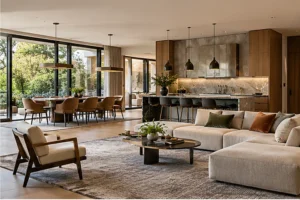
Give Large Rooms Furniture With Enough Presence
Large rooms create the opposite problem.
When furniture is too delicate, it can look as though it has been dropped into the middle of an oversized architectural shell.
A spacious living room generally needs stronger anchors.
This might mean a deeper sofa, larger rug, broad coffee table, substantial armchairs, or oversized lighting.
Recent designer guidance particularly emphasizes furniture depth in open or generous rooms because deeper pieces help the seating area appear grounded and comfortable.
Large rooms do not necessarily need more furniture.
That distinction matters.
Adding ten small objects will not automatically solve a scale problem. Often, four or five larger, well-positioned pieces create a stronger result.
Lighting can help too.
Architectural Digest documents how oversized fixtures and layered rugs can visually reduce the perceived scale of expansive rooms and create more intimate furniture zones.
The aim is to give the architecture enough visual response without filling every available corner.
Consider Circulation as Part of Furniture Scale
A piece is not correctly scaled simply because it fits between two walls.
People still need to move around it.
A large sofa may look wonderful, but if you have to squeeze around its arm every time you cross the room, its scale is probably inappropriate for the layout.
Circulation is therefore part of the scale equation.
Good furniture planning preserves obvious pathways between entrances, seating areas, windows, and adjoining spaces. In narrow rooms particularly, oversized furniture or pieces that interrupt sightlines can make the space feel more confined.
Think about the empty areas around furniture as functional space rather than unused space.
Before buying a large piece, mark its footprint on the floor with painter’s tape. Then walk around it.
Can doors open comfortably? Can someone pass behind the sofa? Is there enough room to pull a dining chair back?
These tests often reveal problems that measurements alone cannot show.
A little breathing room is neccessary for both physical comfort and visual balance.
Match Furniture Scale to Ceiling Height
Furniture has vertical scale as well as horizontal dimensions.
This is easy to overlook.
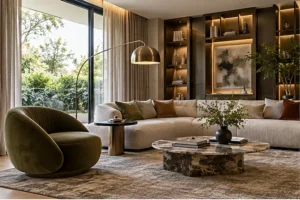
A low sofa, short cabinet, low coffee table, and small lamp can create an attractive horizontal composition in the right setting. Inside a room with very tall ceilings, however, the entire arrangement may appear to sit awkwardly near the floor.
Introduce varied heights.
A tall floor lamp, substantial shelving unit, large artwork, dramatic curtains, or statement plant can visually connect the furniture with the upper volume of the room.
High ceilings usually provide more freedom for grander furniture and vertical accessories, while lower ceilings often suit lower-profile pieces.
Do not exaggerate every object, though.
One or two taller elements may be enough to establish a visual bridge.
The effect should feel proportionaly connected rather than designed purely to fill empty height.
Balance Physical Size With Visual Weight
Two pieces of furniture with identical dimensions can feel completely different in scale.
Why?
Visual weight.
A solid dark walnut cabinet looks heavier than an open metal shelving unit of the same dimensions. A large glass coffee table can appear lighter than a smaller block of stone.
Color influences this too.
Dark, highly saturated furniture often feels more visually dominant, while pale colors and transparent materials tend to recede.
Shape matters as well. Furniture with thick arms, solid bases, heavy upholstery, or bulky silhouettes can occupy more visual space than slender pieces.
This gives you flexibility.
If you need a large dining table in a moderately sized room, choosing a visually lighter design with slimmer legs may reduce its apparent mass. Alternatively, a large room may benefit from more solid forms because they create enough presence.
The goal is not only to measure furniture but to imagine how heavy it will visully feel once placed.
Use Rugs and Accessories to Correct Scale
Sometimes the furniture itself is fine, but the elements around it create the wrong sense of proportion.
Rugs are a classic example.
A sofa can appear oversized when paired with a tiny rug. Increase the rug size and suddenly the furniture looks much more balanced because the seating now sits within a larger visual foundation.
Architectural Digest highlights rug layering as one way to correct scale when a favorite rug is too small for the room. Placing it over a larger neutral foundation allows the original piece to remain while restoring more appropriate proportions.
Artwork and lighting work similarly.
A large sofa under a tiny framed picture often looks heavier than it really is. Replacing that art with a larger piece changes the relationship without moving the sofa at all.
Accessories can correct scale too, but be careful.
In large rooms, one substantial vase or sculptural object may work better than ten miniature accessories. Architectural Digest similarly recommends larger art and accessories for spaces with significant architectural scale.
Sometimes fixing scale is about changing the supporting cast rather than replacing the main furniture.
Leave Negative Space Around Important Pieces
Furniture scale becomes easier to appreciate when objects have room around them.
A beautiful armchair squeezed between a console, plant, table, and sofa may feel much larger than it really is.
Move a few things away and its proportions immediately become clearer.
Homes & Gardens recommends leaving open areas around and above furniture so the eye has places to rest, especially when working with different furniture sizes.
This is particularly valuable when one item is intentionally oversized.
An exaggerated lounge chair, sculptural table, or large sofa can create fantastic drama if it has enough negative space to feel delibarately oversized rather than accidentally cramped.
Large rooms also benefit from emptiness.
Do not treat every unused corner as a styling problem.
The relationship between furniture and room size involves solid forms and empty areas working together.
When the negative space is right, furniture feels more confident and the architecture becomes easier to understand.
Furniture scale and room size have a relationship that goes far beyond basic measurements. Ceiling height, visual weight, circulation, proportion, architecture, and negative space all influence whether a piece feels appropriate.
Small rooms do not always need tiny furniture, and large spaces do not necessarily require more pieces. The better strategy is choosing furniture with enough presence for the architecture while preserving comfortable movement and visual breathing room.
Before purchasing something new, measure your room, mark the proposed footprint, and study how the piece will relate to nearby furniture.
Then step back and consider the overall composition rather than one item at a time.
When scale is right, furniture rarely looks obviously “designed.” It simply feels comfortable, connected, and naturally suited to the room around it.