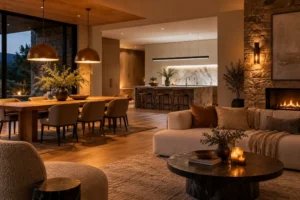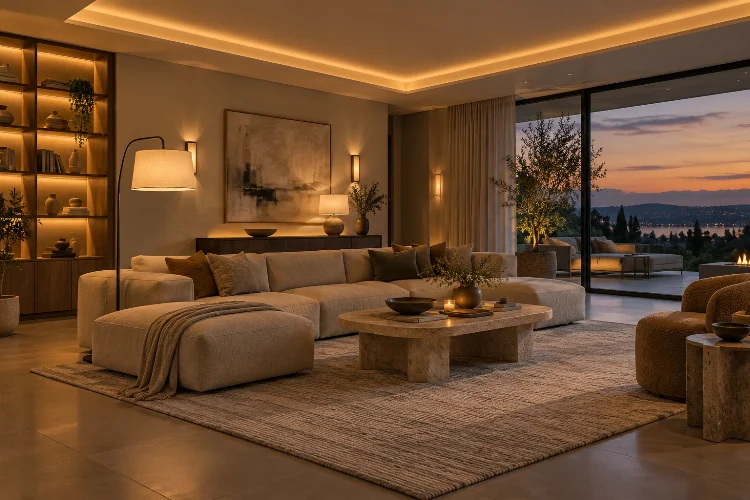
A beautifully designed home can look completely different after sunset. Materials that seemed rich in daylight may suddenly appear flat, architectural details disappear into shadows, and a carefully styled living room can feel surprisingly cold under one harsh ceiling light.
Lighting is often the missing layer.
Layered ambient lighting in contemporary home interiors combines multiple sources instead of asking one fixture to illuminate everything.
Ceiling lights provide general visibility, lamps create softer pools of brightness, accent fixtures highlight architecture, and indirect lighting adds depth without exposing the light source itself.
Professional lighting guidance commonly divides a successful scheme into three main categories: ambient, task, and accent lighting. Each serves a different purpose, and combining them creates greater flexibility throughout the day.
This approach is especially effective in contemporary interiors, where clean architecture and restrained decoration make light itself an important design material.
The goal is not maximum brightness. It is controlling where light appears, what it reveals, and how the room feels when different layers work together.
Start With Ambient Lighting as the Foundation
Ambient lighting is the general illumination that allows people to move comfortably through a room.
It often comes from ceiling pendants, recessed fixtures, chandeliers, or architectural lighting integrated into ceilings and walls. Think of it as the foundation rather than the entire scheme.
The biggest mistake is expecting this first layer to do everything.
A grid of bright recessed lights may illuminate every corner, but uniform brightness often removes depth. Furniture, artwork, and architectural surfaces begin to look equally important because there are few changes in light intensity.
Instead, establish enough general illumination for practical movement and then allow other fixtures to create personality.
Homes & Gardens describes ambient lighting as the primary background layer upon which task and accent lighting are added. Different rooms also need different amounts: kitchens typically require more practical illumination, while bedrooms and living rooms benefit from softer levels.
Ambient light should make a room functional without making it feel like an office.
Add Task Lighting Where Daily Life Actually Happens
Task lighting introduces focused illumination where specific activities take place.
That might mean a floor lamp beside a reading chair, pendants above a kitchen island, under-cabinet lighting over worktops, or a desk lamp in a home office.
The key is positioning it around behavior.
Do not install a reading lamp simply because an empty corner seems to need one. Place it where someone actually sits to read.
This approach allows the overall ambiant layer to remain softer because brighter light is available exactly where necessary.
Task lighting becomes particularly valuable in multifunctional contemporary homes. An open-plan room may need bright kitchen preparation lighting at 6 p.m., comfortable dining illumination at 7 p.m., and much softer lounge lighting later in the evening.
Separate sources allow those activities to coexist without illuminating the entire room at the same intensity.
That flexibility is what makes layered lighting practical rather than purely decorative.
Use Accent Lighting to Create Visual Hierarchy
Accent lighting tells the eye where to look.
Picture lights can emphasize artwork. Directional spots may reveal a textured stone wall. Integrated shelf lighting can transform built-in joinery into an architectural feature.
Without accent lighting, many rooms become visually flat after dark.
Every surface receives similar illumination, so expensive materials and important details lose their hierarchy.
Architectural Digest recommends layering ambient, task, and accent sources while varying fixture heights and using architectural lighting to emphasize selected details.
Think of accent lighting as editing.
You probably do not need every artwork, shelf, plant, and wall to receive its own spotlight. Select the features that actually deserve attention.
A dramatic fireplace might receive directional lighting while surrounding walls remain quieter. A sculptural staircase could be softly illuminated while nearby circulation areas rely on lower-level ambient light.
Selective illumination makes important elements feel even more significant.
Introduce Indirect Lighting for Softer Depth
Indirect lighting is one of the easiest ways to make contemporary interiors feel sophisticated.
Instead of directing the light straight into the room, the fixture sends it toward another surface – often a wall or ceiling – which then reflects a softer glow back into the space.
This reduces harshness and creates a more diffused atmosphere.
ArchDaily explains that indirect lighting can minimize reflected glare and strong shadows while emphasizing architectural features. Hidden LED strips, illuminated shelves, and concealed ceiling details are common applications.
Cove lighting is particularly effective.
A hidden strip near the ceiling can make the entire upper surface glow, adding perceived height without introducing another decorative fixture.
Integrated lighting can also work inside joinery.
Shelves, niches, wall panels, headboards, and cabinets can contain concealed sources that make furniture and architecture appear visually deeper. ArchDaily notes that integrated indirect lighting can add warmth, texture, and dimension while highlighting decorative objects.
The source remains subtile, but the spatial effect can be dramatic.
Use Light and Shadow to Reveal Materials
Contemporary homes often depend heavily on material quality.
Stone, timber, limewash, plaster, concrete, metal, and textured fabrics look very different depending on how they are illuminated.
Flat frontal lighting can remove much of that character.
Directional or grazing light produces shadows across uneven surfaces, revealing texture. A textured plaster wall becomes more sculptural, while timber grain gains greater depth.
Shadow is therefore not something designers always need to eliminate.
A completely evenly illuminated interior can feel lifeless because the eye receives few clues about depth. Recent designer guidance emphasizes that the interplay between light and shadow helps architecture and materials feel more dimensional.
Experiment with light coming from different heights.
Wall sconces, low table lamps, floor lamps, and ceiling fixtures each produce different shadows. Their overlap creates a far richer environment than one central overhead source.
The strongest evening interiors often contain areas that are intentionally quieter.
Darkness can be part of the composition.
Keep Color Temperature Consistent
Brightness is only one lighting decision.
Color temperature matters too.
Measured in Kelvin, it describes whether white light appears warmer or cooler. Homes & Gardens recommends approximately 2700-3000K for warm ambient illumination in living and dining spaces where a relaxed atmosphere is desired.
This range works particularly well with timber, warm stone, neutral textiles, and many contemporary residential palettes.
Mixing dramatically different temperatures within the same open space can feel uncomfortable.
For example, a warm 2700K floor lamp beside a very cool ceiling fixture may make one side of the room appear golden while another looks almost blue.
Task lighting can sometimes be slightly brighter or more neutral where visibility matters, but adjacent fixtures should still feel related.
Consistency becomes especially neccessary in open-concept interiors where the kitchen, dining area, and living room can all be seen simultaneously.
The rooms do not need identical fixtures.
They simply need light that feels as though it belongs to the same environment.
Create Lighting Zones in Open-Concept Homes
Open plans create one large architectural space but several functional environments.
Lighting can define those environments without walls.
Pendants might anchor the kitchen island. A sculptural fixture identifies the dining area. Table and floor lamps create a softer living zone nearby.
The furniture may share one continuous floor, yet each activity receives its own luminous boundary.
This technique works because people read changes in light almost instinctively.
Brighter task lighting suggests activity, while warm pools of lower illumination encourage relaxation.
Homes & Gardens recommends creating lighting zones and using separate sources to help multifunctional spaces adapt without physical partitions.
It also makes the home more efficient from a usability perspective.
You do not need every fixture switched on simply because someone is sitting in one part of the room.
Lighting should respond to how the house is being used at that particular moment.
Use Wall Washing to Change How Large a Room Feels
Lighting can even alter perceived dimensions.
Wall washing directs light broadly across a vertical surface, brightening the boundaries of the room.
ArchDaily notes that illuminating walls can make interiors feel visually larger because those boundaries become brighter and more noticeable rather than disappearing into darkness.
This can be especially useful in narrow hallways, compact living rooms, or spaces with limited natural light.
Uplighting creates another effect.
Directing illumination toward the ceiling can emphasize height and reduce dark overhead areas, while pendant fixtures can deliberately pull attention toward tall ceilings.
These techniques demonstrate why lighting design is about much more than choosing beautiful fixtures.
Light influences how people perceive the actual architecture.
A relatively modest room can feel more expansive when its vertical surfaces are illuminated intelligently.
Put Different Lighting Layers on Separate Controls
Layering loses much of its usefulness if every fixture switches on simultaneously.
Separate controls create flexibility.
Ceiling lights might operate independently from sconces. Integrated shelf lighting can have another circuit, while floor and table lamps function individually.
Dimmers are especially valuable.
Architectural Digest recommends dimmable fixtures because they allow lighting intensity to change with different functions and moods.
A living room may require relatively bright light when guests arrive, softer illumination during dinner, and only table lamps and architectural accents later at night.
Those are three completely different environments created without moving a single piece of furniture.
If you are renovating, plan circuits early.
Retrofitting additional switching can be more complicated once ceilings and walls are finished.
Smart controls can also simplify larger systems, but the basic principle remains the same: each major layer should be adjustable without depending on every other fixture.
Let Decorative Fixtures Become Part of the Interior
Layered lighting does not mean every fixture should disappear.
Contemporary interiors often combine discreet architectural lighting with one expressive decorative piece.
A large pendant, chandelier, or sculptural floor lamp can operate almost like furniture, adding shape even when switched off.
ArchDaily identifies statement lighting as a recurring feature of contemporary interiors, where dramatic fixtures are often combined with restrained recessed or indirect illumination.
This creates hierarchy.
A dining pendant might become the visual centerpiece while hidden ceiling lighting quietly provides background illumination.
The mistake is making every fixture a statement.
Five dramatic pendants, sculptural sconces, oversized lamps, and colored LEDs can quickly create competition.
Choose where lighting should be visible and where it should disappear.
A delibarate mix of decorative and concealed sources usually produces the most sophisticated result.
Layered ambient lighting transforms contemporary interiors because it controls much more than brightness. It creates depth, supports daily tasks, highlights architecture, reveals materials, and allows the mood of a home to change throughout the day.
Begin with comfortable ambient illumination, then add task lighting where activities happen and accent lighting where important features deserve emphasis.
Use indirect sources for softness, maintain compatible color temperatures, and keep major layers independently controllable.
Most importantly, do not try to eliminate every shadow.
Walk through your home after sunset and notice which areas feel flat, overly bright, or forgotten. Adding one floor lamp, illuminated shelf, wall washer, or dimmable accent source in the right location can often produce more atmosphere than simply installing brighter ceiling lights.