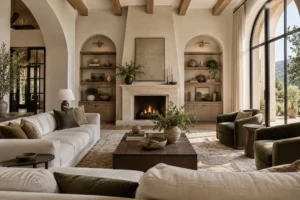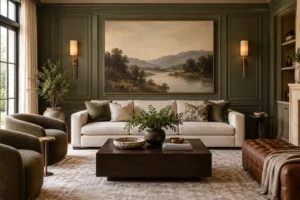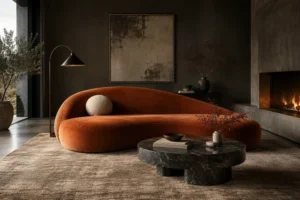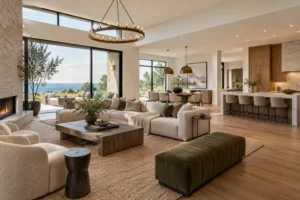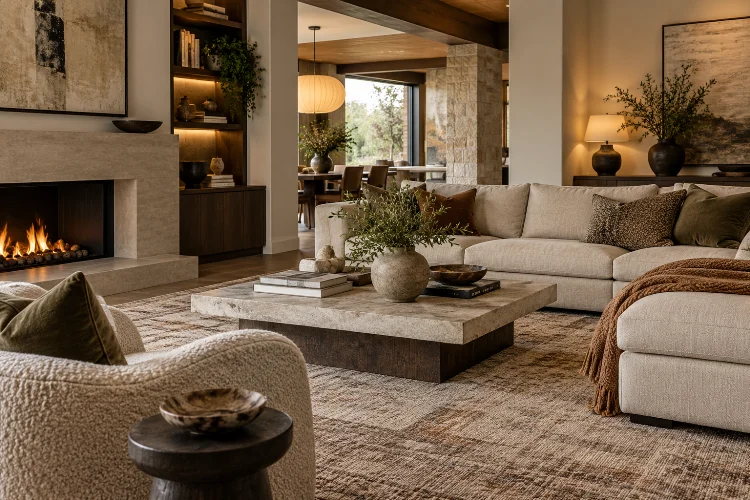
A contemporary living room can have beautiful furniture, expensive finishes, and a carefully chosen color palette yet still feel strangely flat. The problem is often not what is in the room, but how those elements are layered together.
Strong contemporary living room decor creates depth by giving the eye several levels of interest.
Furniture establishes the main structure, rugs ground the composition, lighting creates atmosphere, textiles soften harder surfaces, and smaller decorative objects add personality.
Contemporary design is particularly suited to this approach. Clean architectural lines provide a calm foundation, while layered textures, artwork, natural materials, and statement lighting prevent the space from becoming sterile.
Architectural Digest identifies layered textures, streamlined forms, soft textiles, wood, metal, and natural woven materials as recurring characteristics of contemporary interiors.
The goal, however, is not to keep adding things.
Successful layering is selective. Every new element should introduce texture, height, contrast, warmth, or visual rhythm without making the room feel cluttered.
Build a Calm Base Layer First
Think of your living room as a composition built from the background forward.
The first layer includes walls, flooring, architectural details, large windows, and major built-in elements. Because these surfaces occupy the greatest visual area, they should provide enough consistency to support everything added later.
Contemporary rooms often start with restrained colors such as warm white, stone, taupe, soft gray, or muted earth tones. A quieter base allows furniture, art, and tactile materials to become more noticeable without competing with the architecture.
That does not mean walls need to be completely plain.
Textured plaster, subtle paneling, timber detailing, or lightly veined stone can create visual interest before furniture enters the room. The key is allowing those surfaces to function as background layers rather than making every wall a focal point.
Once the foundation feels coherent, smaller decorative decisions become much easier.
Anchor the Room With Appropriately Scaled Furniture
Furniture creates the strongest middle layer of the room.
Start with the largest pieces: usually the sofa, lounge chairs, coffee table, and perhaps a substantial media or storage unit. These elements determine how visual weight is distributed.
Avoid arranging every piece directly against the walls simply to maximize open floor area. Floating selected furniture inward can create overlapping visual planes, making the space feel deeper and more intentional.
Varying heights also matters.
A low contemporary sofa paired only with low tables creates a strong horizontal line but can eventually feel visually flat. Introduce a taller floor lamp, indoor tree, shelving system, or vertical artwork to move the eye upward.
This variation creates dimension while preserving the clean silhouettes associated with contemporary interiors.
Large furniture should establish structure; smaller items should support it rather than compete with it.
Layer Rugs to Create Depth From the Floor Up
The floor offers one of the easiest opportunities to add another visual layer.
A well-scaled rug helps connect seating pieces while introducing color, softness, pattern, or texture. Homes & Gardens notes that living room rugs can add warmth and establish an inviting layer of texture, particularly when contrasted against harder flooring materials.
Layering two rugs can add even more dimension.
For example, start with a large natural-fiber rug in jute or sisal and place a smaller wool or patterned rug over it. The lower layer provides scale and texture, while the upper piece introduces stronger personality.
This approach works particularly well in contemporary rooms dominated by neutral furniture.
Recent examples of layered living rooms also show how mixing rug textures and patterns can introduce depth and definition without requiring major architectural changes.
Just keep scale in mind. Rugs that are too small can make furniture appear visually disconnected.
Mix Textures Instead of Simply Adding More Color
If a neutral living room feels boring, color may not actually be the problem.
Texture could be missing.
Contemporary interiors become richer when smooth and rough, soft and hard, matte and reflective surfaces appear together. Designers increasingly use texture schemes to add dimension even when the overall color palette remains restrained.
Imagine a cream sofa surrounded by a boucle chair, wool rug, timber coffee table, linen curtains, ceramic vase, and brushed-metal lamp.
The colors may all remain relatively quiet, but every material responds differently to light and touch.
This creates much greater depth than simply adding several bright cushions.
Try combining around three or four noticeably different textures within the main seating area. Natural timber can balance smooth stone, while soft upholstery counteracts glass or metal.
The effect should feel tactille rather than busy.
Create Depth Through Layered Lighting
Lighting changes the way every other decorative layer is perceived.
A room illuminated only by one central ceiling fixture often appears visually flat because all surfaces receive approximately the same treatment.
Layered lighting creates multiple areas of brightness and shadow.
A practical arrangement might include ceiling lighting for overall illumination, a floor lamp beside the sofa, a table lamp near a reading chair, and accent lighting directed toward artwork or shelving.
Designers frequently recommend combining ceiling, wall, floor, and table-level light sources to give living rooms greater depth and flexibility.
Height variation is important here too.
A pendant operates at one level, wall sconces occupy another, and low lamps create smaller pockets of warmth closer to furniture.
At night, those overlapping pools of light can make a contemporary room feel significantly more dimensional than uniform overhead lighting.
Whenever possible, use dimmers so the hierarchy can change according to the time of day.
Use Artwork to Add a Vertical Layer
Once the furniture and floor are established, look at the walls.
Artwork provides an important vertical layer that connects furniture with the architecture around it.
A large contemporary painting above a sofa can create a stronger sense of scale than several small unrelated pieces. Alternatively, a carefully arranged gallery wall can add rhythm and complexity.
Art should not be treated seperately from the furniture below it.
Consider color relationships, shapes, dimensions, and visual weight. If your sofa is broad and visually substantial, extremely small artwork may appear disconnected.
Mirrors can create another kind of depth.
Placed opposite or adjacent to windows, they reflect light and parts of the room, visually extending the space. Sculptural wall pieces can also introduce shadows and physical dimension that flat artwork cannot provide.
The wall layer should strengthen the overall composition rather than simply cover empty surfaces.
Add Smaller Objects in Different Heights and Shapes
Decorative accessories are usually the final physical layer.
Coffee-table books, ceramics, trays, bowls, sculptures, plants, candles, and small objects add personality. However, this is also the stage where layering can become clutter.
Instead of scattering many unrelated items everywhere, create smaller compositions.
On a coffee table, for example, you might combine a low stack of books, a medium-height ceramic object, and a taller vase. The variation creates a miniature skyline rather than a row of objects sitting at the same level.
Natural elements are particularly useful for breaking up rigid contemporary forms. Architectural Digest notes that greenery, tactile wood finishes, textiles, and decorative objects can introduce warmth and physical layers even within minimalist living rooms.
Leave some surfaces partly empty.
Negative space is what allows styled objects to be noticed.
Use Contrast to Separate the Layers
Without contrast, different layers can visually merge.
Contrast does not always require dramatic color differences. You can contrast shape, texture, scale, finish, or age.
A curved lounge chair creates contrast against straight architectural lines. A dark side table becomes more noticeable beside pale upholstery. Handmade pottery introduces irregularity against highly precise contemporary cabinetry.
Old and new pieces can also create depth.
A vintage timber stool or antique ceramic vessel inside an otherwise modern space immediately introduces another visual timeline. Contemporary design often works well with this kind of juxtaposition rather than requiring every piece to come from the same collection.
Use these contrasts in a delibarate way.
If every object introduces a new color, material, shape, and design era, the room stops feeling layered and starts feeling chaotic.
Edit the Room Before Adding Another Layer
Layering does not mean filling.
In fact, editing is what usually separates sophisticated rooms from cluttered ones.
Step away from the space and identify which elements your eye notices first. Ideally, there should be some hierarchy: perhaps artwork first, then the sofa, followed by lighting and smaller objects.
If everything demands equal attention, remove something.
A successful contemporary scheme often combines texture and personality with restraint. Recent professionally designed living rooms demonstrate how thoughtful mixes of finishes, fabrics, furniture, and color can produce depth while remaining polished and cohesive.
Pay particular attention to cushions and small accessories. Adding ten similar cushions rarely creates more depth than carefully combining three or four with different sizes and materials.
A consistant material or color thread can then connect the layers without making them identical.
Visual depth depends as much on what you leave out as what you add.
Layering contemporary living room decor is about building visual interest gradually rather than filling the room with more objects.
Start with a calm architectural foundation, establish appropriately scaled furniture, and then introduce rugs, textures, lighting, artwork, and accessories in distinct layers.
Variation creates depth, but repetition keeps everything connected.
Mix soft and hard materials, combine different heights, create overlapping pools of light, and use contrast where you want the eye to pause. Most importantly, preserve enough negative space for each layer to remain visible.
Take a fresh look at your living room and identify which layer feels weakest. Instead of completely redecorating, improve that one area first.
Sometimes a larger rug, textured throw, better lamp, or carefully positioned artwork is enough to make the entire room feel richer and more dimensional.