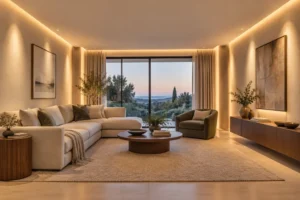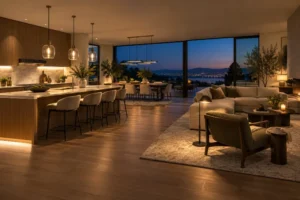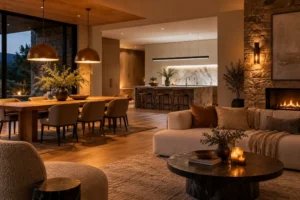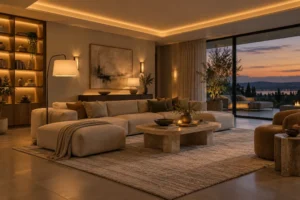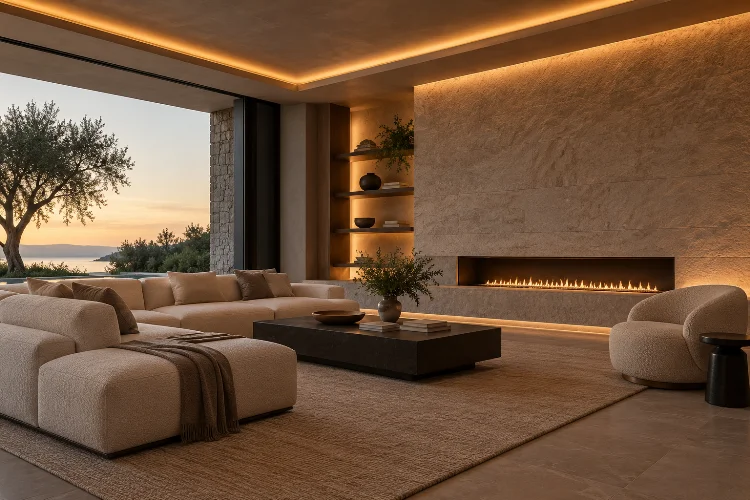
The most sophisticated lighting is often the lighting you barely notice.
Instead of seeing a bright bulb or obvious spotlight, you notice the glow washing across a textured wall, the gentle illumination beneath a shelf, or the soft light reflecting from the ceiling. The source seems to disappear, leaving the architecture itself illuminated.
That is the power of indirect lighting strategies for sophisticated interiors.
Indirect lighting directs illumination toward another surface – usually a wall, ceiling, panel, or piece of joinery – before it enters the room. This reflected light creates a softer and more evenly distributed effect than many direct sources. It can also reduce harsh shadows and reflected glare.
But sophisticated lighting is not simply about hiding LED strips everywhere.
The best schemes use indirect illumination selectively, combining it with task lights, decorative fixtures, and controlled darkness. The result is an interior with greater depth, atmosphere, and architectural clarity.
Understand What Makes Indirect Lighting Different
Direct lighting sends illumination straight toward a surface or activity. A reading lamp pointing at a book and a pendant illuminating a dining table are obvious examples.
Indirect lighting takes another route.
The source is positioned so light first strikes a wall, ceiling, shelf, or another reflective surface. That surface then distributes the illumination back into the room.
This creates a softer effect because the architecture effectively becomes part of the lighting system.
ArchDaily notes that indirect lighting reduces strong shadows and reflected glare, making it particularly useful around reflective surfaces such as televisions, mirrors, and computer screens.
The technique works particularly well in contemporary homes because it supports clean visual lines.
Instead of making the fixture the focal point, the lighting emphasizes volume, material, and architecture.
That distinction is important. Sophisticated illumination is often less about seeing the lamp and more about seeing what the lamp reveals.
Use Cove Lighting to Give Ceilings More Depth
Cove lighting is one of the most recognizable forms of indirect illumination.
A concealed light source sits within a recessed architectural detail and directs its output upward toward the ceiling. The ceiling then reflects a broad, soft glow back into the space.
This can make a room feel more dimensional after dark.
Cove lighting is especially effective in living rooms, bedrooms, dining spaces, and hallways where strong overhead brightness is unnecessary.
Architectural lighting guidance describes hidden cove illumination as an effective way to wash walls or ceilings without exposing the light source, creating a clean contemporary appearance.
The detail matters, however.
If the LED strip is visible from normal viewing positions, the illusion disappears. Poorly positioned strips can also create noticeable bright lines rather than a smooth glow.
The most toughtful designs conceal the source deeply enough that you experience the illumination rather than the hardware producing it.
Dimming is also valuable because cove lighting rarely needs maximum output throughout the evening.
Wash Walls to Make Rooms Feel Larger
Indirect illumination does not always need to focus on ceilings.
Lighting vertical surfaces can completely change how spacious a room feels.
Wall washing spreads light broadly across a wall, making its boundary brighter and more visually prominent. ArchDaily notes that illuminating walls can virtually expand an interior because brighter boundaries make the perceived space feel more open.
This is particularly effective in narrow rooms, hallways, compact living areas, and interiors with relatively little natural daylight.
Wall washing can also highlight architectural finishes.
A limewashed wall, natural stone surface, timber paneling, or textured plaster can become dramatically more interesting under carefully controlled illumination.
However, placement needs to respond to texture.
A smooth wall usually benefits from even illumination, while a deeply textured surface may look more dramatic when the light creates slightly stronger shadows.
The goal should determine the technique.
If you want the wall to appear calm and expansive, prioritize evenness. If you want texture and depth, allow light and shadow to interact more visibly.
Integrate Hidden Lighting Into Joinery
Built-in furniture offers another opportunity for discreet lighting.
Shelves, display cabinets, wardrobes, kitchen joinery, headboards, and media units can all incorporate concealed illumination.
The effect can be surprisingly architectural.
Instead of seeing one large dark cabinet after sunset, individual recesses and surfaces become visible. Shelves appear deeper, decorative objects become more important, and the furniture seems visually connected to the room.
ArchDaily highlights integrated furniture and woodwork lighting as a way to add warmth, dimension, and atmosphere while emphasizing objects and material details.
Placement should remain subtile.
LED strips mounted too close to the front edge may become visible or create uncomfortable hotspots. Positioning them behind lips, within channels, or toward the back of shelving usually produces a cleaner result.
You also do not need to illuminate every shelf.
Selective lighting creates hierarchy. One beautifully lit niche can feel much more sophisticated than an entire wall glowing at equal intensity.
Use Uplighting to Strengthen Vertical Architecture
Uplighting directs illumination toward the ceiling or upper portions of a room.
It is particularly useful where architecture already contains strong vertical features.
Tall walls, columns, vaulted ceilings, exposed beams, and double-height spaces can all benefit from light that encourages the eye to move upward.
Architectural lighting references note that uplighting can emphasize ceiling structure while reducing dark overhead zones and helping an interior feel more spacious.
The source itself might come from floor-integrated fixtures, concealed ledges, wall-mounted uplights, or furniture.
In a luxury living room, for example, hidden illumination behind a console can softly brighten a stone wall. In a hallway, low-level sources can emphasize vertical panels without requiring a decorative ceiling fixture.
Avoid using uplighting indiscriminately.
If every wall and ceiling edge glows, the room can begin to resemble a commercial lobby.
Choose architectural elements that genuinely deserve emphasis.
Layer Indirect Light With Direct Sources
Indirect illumination is excellent for atmosphere, but it should rarely be responsible for every visual task.
A room still needs practical light.
A kitchen requires clear illumination over counters. A reading chair benefits from a focused lamp. A dining table may need a pendant that directs brightness toward its surface.
This is why sophisticated interiors typically combine several lighting layers.
Homes & Gardens recommends positioning lighting at different levels and thinking carefully about the visual hierarchy between decorative fixtures, recessed sources, cabinet lighting, LED tape, and cove illumination.
Think of indirect light as the background layer.
It shapes the atmosphere and makes architecture visible. Direct lighting then provides functional brightness where necessary.
For example, a living room might use concealed ceiling lighting for ambience, a floor lamp for reading, and a picture light for artwork.
Each source has a job.
When every fixture tries to do everything, the lighting becomes unnecessarily bright and visually flat.
Pay Attention to Reflective Surfaces and Materials
Indirect lighting depends heavily on the surface receiving the light.
A pale matte ceiling reflects illumination differently from dark timber. Polished stone can create stronger reflections than rough plaster.
This means the material palette should be considered during lighting design.
Light-colored surfaces generally return more illumination into the room, while darker finishes absorb more and may require higher output.
Highly reflective materials create another challenge.
Glossy stone, glass, mirrors, television screens, and polished metal can reveal unwanted reflections if the light source is positioned poorly.
Indirect lighting can reduce this problem because the illumination arrives from a broader reflective surface rather than a concentrated exposed source.
Test lighting against actual materials whenever possible.
A warm stone wall might become beautifully layered under concealed light, while a glossy panel nearby may produce an annoying reflection from exactly the same fixture.
The most refined schemes respond individualy to each finish.
Control Color Temperature and Dimming
Indirect light is often used to create atmosphere, so color temperature matters.
Warm residential lighting generally makes timber, brass, warm stone, and neutral fabrics feel more inviting. Cooler light can emphasize cleaner contemporary finishes but may feel clinical when used excessively in living spaces.
More important than chasing one perfect number is consistency.
If a warm cove light sits beside a dramatically cooler wall washer, the difference may become distracting.
Dimming provides another level of control.
Indirect illumination that feels perfect during an evening gathering may appear too bright late at night. Being able to reduce the output lets architecture remain visible without dominating the room.
Recent interior lighting guidance also emphasizes layering several light sources and maintaining compatible color temperatures to avoid a fragmented visual effect.
A sophisticated lighting scheme should adapt rather than remain fixed.
Avoid the “LED Strip Everywhere” Problem
Concealed LED technology has made indirect lighting easier to install, but that does not mean every shelf, ceiling edge, stair tread, wall panel, and cabinet should glow.
Too much indirect lighting can remove contrast.
If every architectural line is outlined with light, the eye has nowhere to rest. The space may start to feel theatrical instead of elegant.
Choose lighting according to hierarchy.
Perhaps the ceiling cove establishes the main ambient layer, while integrated shelving provides one secondary feature. Other surfaces can remain intentionally darker.
ArchDaily’s examples of successful indirect lighting demonstrate that the technique works particularly well when it highlights specific architectural features or separates functional zones rather than illuminating everything uniformly.
Darkness is not a design failure.
Shadow creates contrast, and contrast makes illuminated surfaces more noticeable.
The most delibarate lighting plans understand that not every surface needs attention.
Plan Indirect Lighting Early in the Design Process
Many of the best indirect-lighting details are architectural.
Coves require ceiling coordination. Concealed channels need space inside cabinetry. Integrated wall washing may influence plasterwork or joinery dimensions.
That means lighting should be discussed early.
Adding concealed illumination after construction is complete can lead to visible wiring, awkward surface-mounted channels, or compromises in fixture placement.
Coordinate lighting with ceilings, cabinetry, wall panels, power supplies, drivers, and controls before finishes are installed.
Maintenance matters too.
A beautifully concealed LED strip becomes frustrating if replacing the driver requires opening an entire ceiling.
Good detailing should conceal the equipment while keeping essential components accessible.
This is where sophisticated lighting becomes more than decoration.
The invisible technical planning allows the final effect to appear effortless.
Indirect lighting can transform an interior without demanding visual attention from the fixture itself. Cove lighting adds ceiling depth, wall washing can expand perceived space, integrated joinery lighting highlights craftsmanship, and uplighting strengthens vertical architecture.
The best results come from restraint.
Combine indirect illumination with practical direct lighting, choose compatible color temperatures, use dimmers, and pay attention to how different materials reflect light. Most importantly, resist the urge to illuminate every architectural line.
Look around your home after dark and identify one surface that deserves more presence – a textured wall, ceiling, shelving unit, or architectural niche. Improving that single layer strategicly can create more sophistication than adding several highly decorative fixtures.